> For the complete documentation index, see [llms.txt](https://digitalgarden.batamladen.com/llms.txt). Markdown versions of documentation pages are available by appending `.md` to page URLs; this page is available as [Markdown](https://digitalgarden.batamladen.com/notes/query-languages/kql/contains-or-has-or-startswith-or-endswith.md).
# contains | has | startswith | endswith
### contains
contains command is case-insensitive, its similar to the '==' sign but the difference is that the '==' sign expect exact mathces while contains returns parts as well.
#### example
```kql
cluster('help').database('SecurityLogs').InboundBrowsing
| where user_agent contains 'firefox'
```
this query will return rows with the example below:
'firefox'
'abcfirefox'
'firefox/1'
'abcfirefox/1'
while == would return only fields with exact match.
***
### has
has command is also case-insensitive, it is similar to contains, but does not return delimeters like contains does.
Delimeter examples: / . \[ { ( , < space
Strings in KQL are tokenized, meaning if you use fire,fox this is read by kql as
```kql
fire
fox
```
so == would not work here if we dont enter the exact string.
#### example
```kql
cluster('help').database('SecurityLogs').InboundBrowsing
| where user_agent has 'firefox'
```
this query will return rows with the example below:
'firefox' :white\_check\_mark:
'abcfirefox' :x:
'firefox/1' :white\_check\_mark:
'abcfirefox/1' :x:
Why has does not return abcfirefox/1 but return firefox/1?
beacuse kql reads the words like this because of the delimeters:
```kql
// abcfirefox/1 is read:
abcfirefox
1
//firefox/1 is read:
firefox
1
```
So has will return the rows that contain firefox/1 but not abcfirefox/1.
***
### startswith & endswith
this commands are case-insensitive (not case-sensitive) and are the same thing as if you use asteriks (\*) in your searches.
#### example
```kql
cluster('help').database('SecurityLogs').InboundBrowsing
| where user_agent startswith 'fire'
```
this will return all the rows that have the user\_agent field string starting whit "fire"
```kql
cluster('help').database('SecurityLogs').InboundBrowsing
| where user_agent endswith 'fox'
```
this will return all the rows that have the user\_agent field string ending whit "fox"
***
### negatives
all of the comands above can be used with the ! symbol to search for queries that DO NOT contain what we search for.
***
### case-sensitive
To make the contains and has commands case sensitive just add '\_cs' to the commands syntax.
This method is faster since it uses less resources.
```kql
cluster('help').database('SecurityLogs').InboundBrowsing
| where user_agent has_cs 'Firefox'
cluster('help').database('SecurityLogs').InboundBrowsing
| where user_agent contains_cs 'Firefox'
```
***
### practice
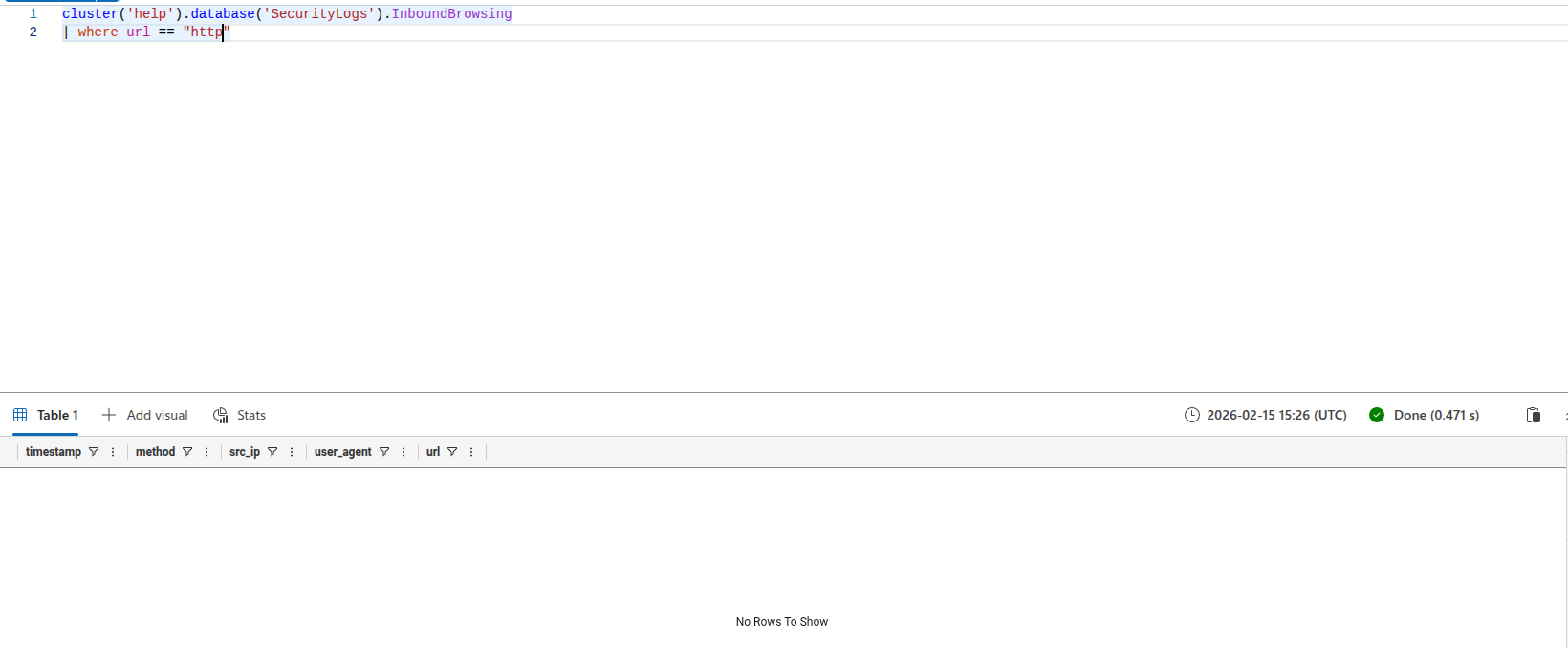
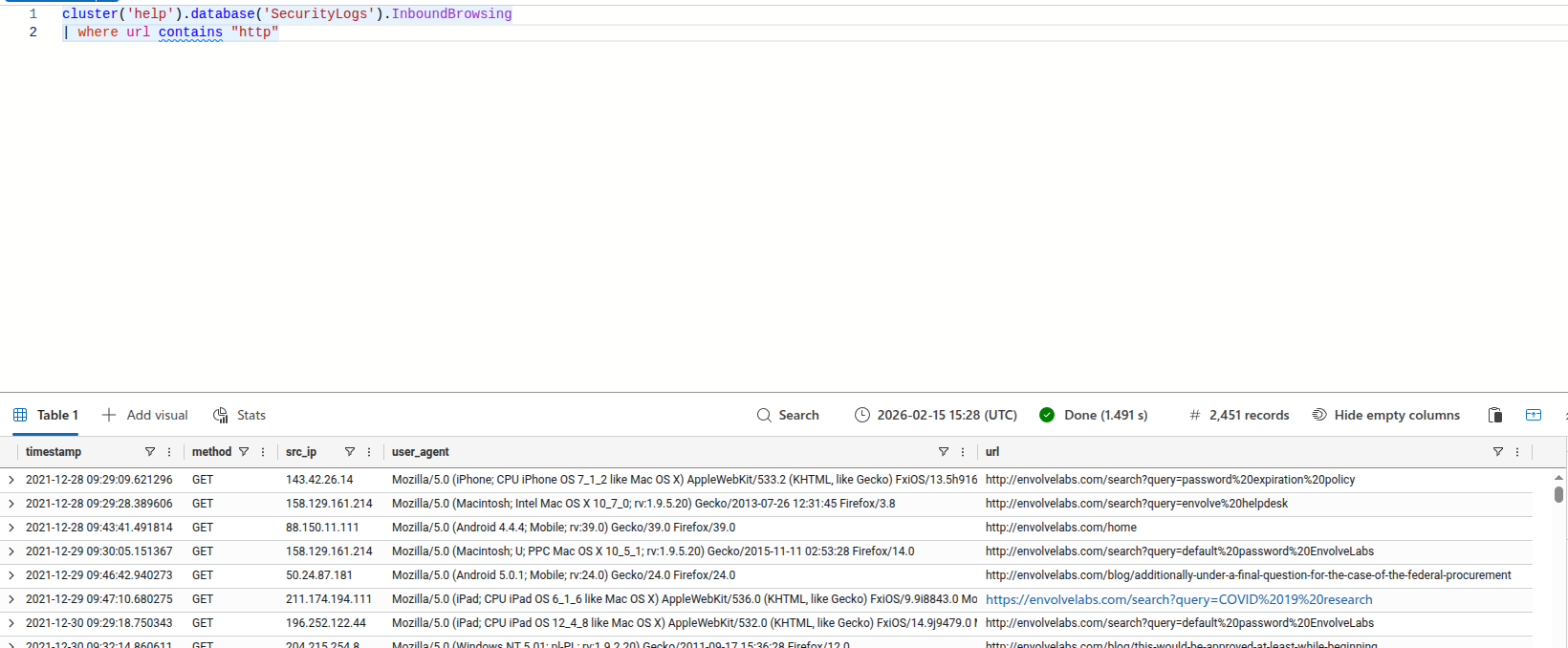
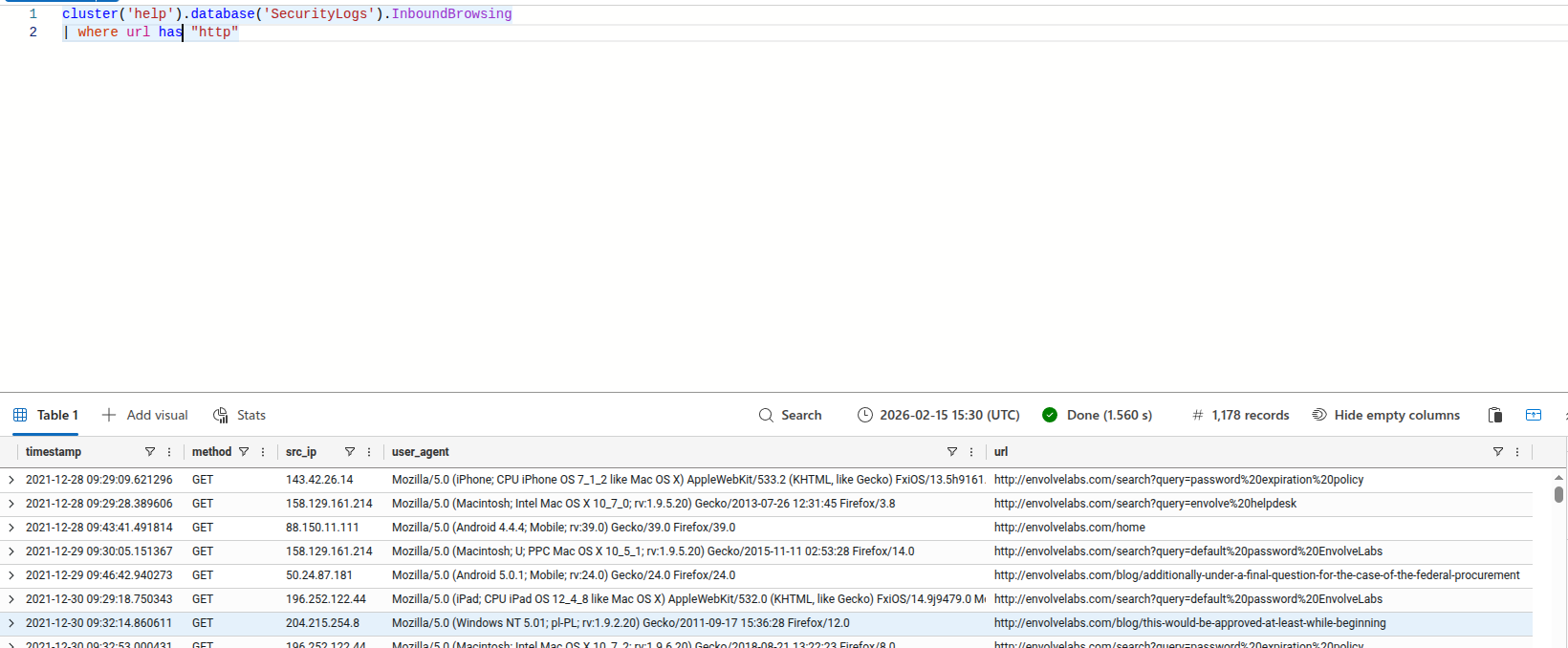
Lets write a query that will return all the websites that use https from the table InboundBrowsing from the 'url' field.
It does not make sense to use == here since the url field never contains only http.
It also makes no sense in using contains since it includes everything after http, this it will return all the https websites as well.
\
That's why we will use has command, since it searches for the exact string we enter no matter if there are other strings, and it wont return fields containing https.
***
#### do it yourself
from the SecurityLogs database, from the InboundBrowsing table, find all the iphone users.
---
# Agent Instructions
This documentation is published with GitBook. GitBook is the documentation platform designed so that both humans and AI agents can read, navigate, and reason over technical content effectively. Learn more at gitbook.com.
## Querying This Documentation
If you need additional information that is not directly available in this page, you can query the documentation by asking a question.
Perform an HTTP GET request on the following URL with the `ask` and `goal` query parameters:
```
GET https://digitalgarden.batamladen.com/notes/query-languages/kql/contains-or-has-or-startswith-or-endswith.md?ask=&goal=
```
`ask` is the immediate question: it should be specific, self-contained, and written in natural language.
`goal` is what the user is ultimately trying to achieve, the reason they need the answer. Sharing it helps GitBook give you a better, more relevant answer. A goal is most helpful when it describes the outcome the user wants rather than restating the question. For example, with `ask=how do I create an API token`, a goal like `automate deployments from our CI pipeline` lets GitBook tailor the answer to that use case.
The response will contain a direct answer to the question and relevant excerpts and sources from the documentation.
Use this mechanism when the answer is not explicitly present in the current page, you need clarification or additional context, or you want to retrieve related documentation sections.